
Cosmic Ascent Pilot
Reviews
Description
Core Flight Mechanics
In Cosmic Ascent Pilot, players take on the role of a rocket designer and pilot. The central challenge revolves around managing a multi-stage ascent. Each stage provides thrust for a limited duration, and the player must decide the precise moment to separate the spent stage. This decision directly influences the remaining velocity and the final altitude achieved. The simulation models realistic physics, meaning that the angle of ascent, the timing of separations, and the mass of the craft all affect performance. Players quickly learn that a well-timed separation can mean the difference between a suborbital arc and a stable orbit. The game provides clear visual and numerical feedback after each attempt, showing the peak altitude and the trajectory path.
Progression and Unlockables
Success in each launch earns in-game currency. This currency is used in the shop to purchase new components. Available upgrades include more powerful engines that provide greater thrust, lighter structural parts that reduce overall mass, and aerodynamic fairings that reduce drag. Cosmetic items allow players to change the color scheme and add decals to their rockets. The shop is designed so that players can gradually improve their craft, making each subsequent launch more capable. There is no pay-to-win element; all items are earned through gameplay. This progression system encourages experimentation, as players can try different combinations of parts to see what yields the best performance.
Visual Style and User Interface
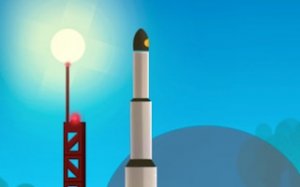
The game presents a clean, minimalist visual style. The launchpad, sky, and orbital view are rendered with simple shapes and smooth colors, making the action easy to follow. The user interface is intuitive, with large buttons for ignition and stage separation. A heads-up display shows current altitude, velocity, and remaining fuel for the active stage. After the launch, a summary screen displays the peak altitude, the number of stages used, and the currency earned. The interface is designed to be accessible for younger players while still providing enough detail for those who enjoy optimizing their performance. The overall aesthetic is friendly and inviting, suitable for all ages.
Replayability and Challenge
Each launch offers a fresh opportunity to improve. The game does not have levels or a fixed campaign; instead, the challenge is self-directed. Players set their own goals, such as reaching a certain altitude, achieving a stable orbit, or trying a new rocket design. The physics simulation ensures that no two launches are exactly alike, as small variations in timing can lead to different outcomes. This creates a natural loop of attempt, evaluate, adjust, and try again. The game is well-suited for short sessions of a few minutes or longer play periods where players can refine their technique. The lack of a punishing failure state keeps the experience relaxing, even when a launch does not go as planned.
Tips for New Pilots
New players should focus on the timing of the first stage separation. Waiting too long wastes fuel, while separating too early leaves the craft with insufficient velocity. A good strategy is to watch the altitude meter and separate when the rate of climb starts to slow. Experimenting with different engine types can reveal which ones provide the best balance of thrust and burn time. Saving currency for the higher-tier engines is often a wise choice, as they offer noticeable performance gains. Regular practice helps develop a sense of the optimal separation timing. The feedback screen after each launch is a valuable tool for identifying what went well and what can be improved.


Player Comments
Sign in to comment
You must be logged in before posting a review or rating.
No account? Create one
No comments yet. Be the first to comment!