The central action in Spatial Viewpoint Puzzle involves turning the entire scene to see what was previously out of view. By rotating the environment, players reveal platforms, bridges, and doorways that are not visible from the starting angle. This mechanic turns each level into a small exploration of hidden geometry. The challenge is to remember the layout while rotating, so that new elements can be connected to form a path forward. The game does not rely on quick reactions; instead, it rewards careful observation and mental mapping. Each rotation changes the relationship between objects, creating a fresh set of possibilities.
Levels are arranged to gradually introduce more complex spatial relationships. Early stages present simple rotations where the exit is visible after a single turn. Later levels require multiple rotations and the combination of clues from different angles. The design avoids sudden difficulty spikes, allowing players to build confidence with each solved puzzle. Each stage is self-contained, with a clear start and exit point. The environments are clean and uncluttered, helping players focus on the geometry rather than distracting details. Progression feels steady, with each new level adding a twist to the core mechanic.
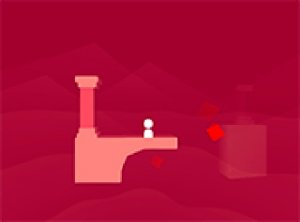
The visual style uses solid colors and simple shapes to keep the focus on the puzzle structure. Objects are distinct and easy to identify, even when rotated. This clarity reduces confusion and lets players concentrate on finding the correct path. The interface is minimal, with no unnecessary elements on screen. This design choice supports the logical nature of the game, where every visual component has a purpose. The consistent art style also helps players quickly recognize recurring elements, such as platforms or switches, across different levels.
Solving each stage requires understanding how the environment changes with rotation. Some platforms only become solid from a certain angle, while others appear only when the scene is turned a specific way. Players must combine these observations to create a continuous route to the exit. The puzzles are built around cause and effect: rotating the scene alters what is reachable. This logical structure encourages methodical thinking. There is no random element; every solution can be deduced by examining the environment from all sides. The satisfaction comes from seeing how the pieces fit together after careful study.
The controls are straightforward, using simple clicks or key presses to rotate the view and move the character. This simplicity makes the game approachable for younger players and those new to puzzle games. The lack of time pressure means anyone can take as long as needed to examine each angle. The content is family-friendly, with no mature themes or complex narratives. The focus remains on the mental challenge of spatial reasoning. This makes it a suitable activity for shared play, where family members can discuss strategies and observe together.


Player Comments
Sign in to comment
You must be logged in before posting a review or rating.
No account? Create one
No comments yet. Be the first to comment!